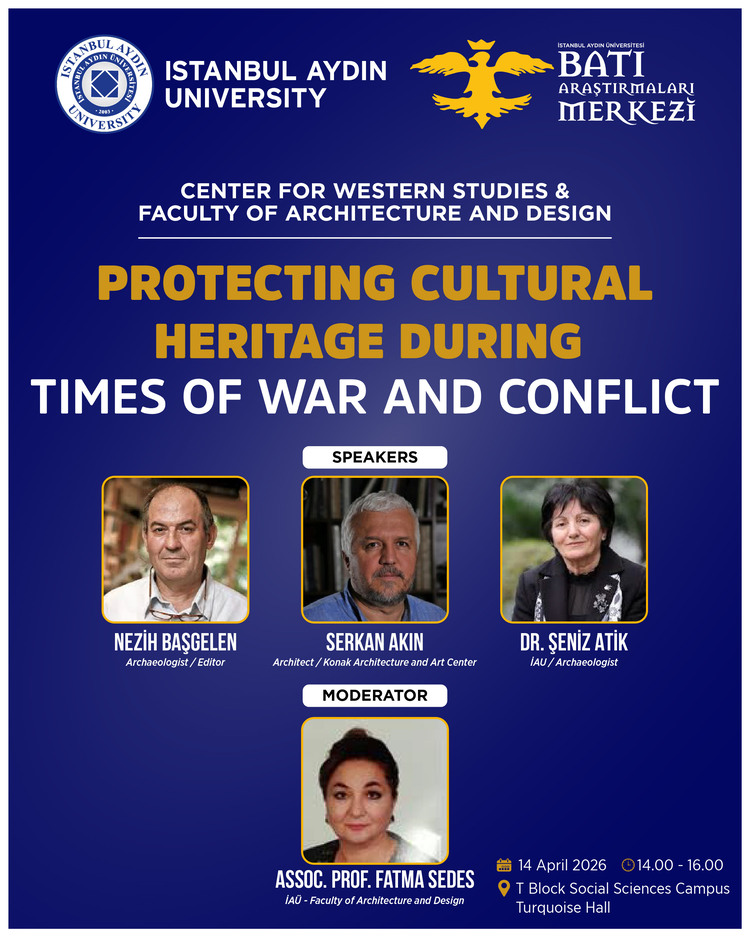
Opening speech by Prof. Dr. Ufuk Fatih KÜÇÜKALİ, Dean of the Faculty of Architecture and Design, at the panel titled “Protecting Cultural Heritage in Times of War and Conflict

Distinguished guests, esteemed academics, dear students,
On behalf of the Faculty of Architecture at Istanbul Aydın University, I respectfully greet you all and welcome you to our panel titled “Protecting Cultural Heritage in Times of War and Conflict.” Cultural heritage is not only a legacy we have inherited from the past; it is also the carrier of our identity, our memory, and our shared human values. Tangible assets—historical buildings, monuments, archaeological sites—and intangible values—language, tradition, folklore—together constitute the soul of a society. Unfortunately, however, wars and conflicts have been one of the greatest threats to this heritage throughout history. The conservation efforts that began with the Hague Conventions signed at the end of the 20th century have gained an important place in international law. In particular, the conventions developed under the umbrella of UNESCO have enabled significant steps to be taken towards the protection of cultural assets. Despite all these efforts, the destruction we have witnessed shows us that there is still a long way to go. For example, many historic cities in Europe suffered heavy damage during World War II. The bombing of Dresden or the near-total destruction of Warsaw demonstrate that not only physical damage but also cultural memory was targeted. More recently, the destruction of the Mostar Bridge during the Bosnian War is a striking example of how cultural heritage becomes a symbolic target in conflicts between identities. In the Middle East, the destruction of the ancient city of Palmyra has shown how a unique heritage of human history can be irreversibly damaged. The looting of the Mosul Museum in Iraq and the destruction of the Bamiyan Buddha statues in Afghanistan are other painful examples of this destruction. All these examples clearly show us that cultural heritage is often targeted not only as a “side effect” of war, but consciously. Therefore, the issue of protection should not be limited only to legal regulations; International cooperation, interdisciplinary studies, and the participation of all segments of society should be addressed. At this point, our universities, research centers, and architects bear a great responsibility. We need to combine scientific knowledge with ethical responsibility for the documentation, preservation, repurposing, and transmission of cultural heritage to future generations. This panel we are holding here today is part of that responsibility. We are delighted to host distinguished figures in their fields at this event, jointly organized by the Western Studies Research and Application Center and our dean’s office. I would like to thank Mr. Nezih Başgelen, Mr. Serkan Akın, Mr. Şeniz Atik, and our esteemed moderator, Mr. Fatma Sedes, for their contributions. I would also like to extend my special thanks to Ms. Filiz Çele, Director of the Western Studies Research and Application Center, for her significant contribution to the realization of this meeting. Distinguished participants, The preservation of cultural heritage is not only about preserving the past; it is also about building the future. Because societies that cannot preserve their identity cannot build a sustainable future. Therefore, preserving cultural heritage during times of war and conflict actually means preserving the common conscience of humanity. I hope this panel will raise awareness on this issue, pave the way for new collaborations, and contribute to the development of solution-oriented approaches. Thank you all for your participation, and I wish you a productive and inspiring panel. Sincerely,