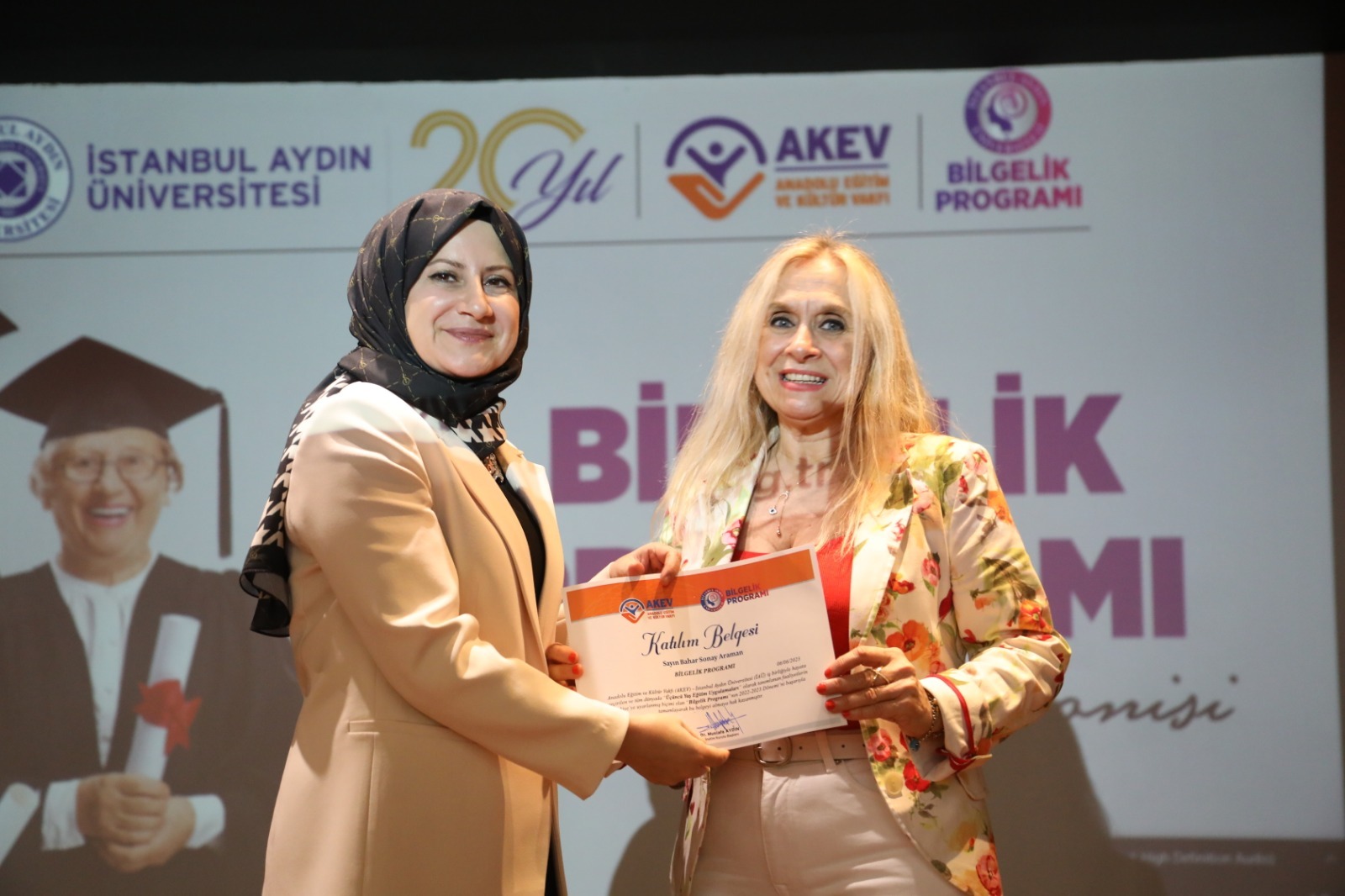

The year-end event of the Wisdom Program, which aims to bring a different perspective to the aging process of society and support a healthy and successful aging period, was held. Established through the cooperation of the Anatolian Education and Culture Foundation (AKEV) and Istanbul Aydın University (IAU), the Program was also founded to help individuals over the age of 60 both in their fight against Alzheimer’s disease and to add value to their social lives.
Students of the “Wisdom Program,” which was launched to enable individuals over the age of 60 to acquire 21st-century skills and to reintegrate them into social life, experienced the well-deserved pride of completing their first year. Adults who do not want to withdraw into isolation after retirement and who once again prove the saying “there is no age limit to learning” also have the opportunity to relive their university experience from nearly half a century ago.
Third-age universities have now become the destination for those who do not want to drift away from social life after retirement. The Wisdom Program, which aims to bring a different perspective to the aging process of society and help individuals achieve a healthy and successful aging period, is one of these initiatives. Established through the cooperation of the Anatolian Education and Culture Foundation (AKEV) and Istanbul Aydın University (IAU), the Program was also founded to help individuals over the age of 60 in their fight against Alzheimer’s disease and to add value to their social lives. With a curriculum similar to undergraduate education, training programs scheduled two days a week for three hours a day and delivered by volunteer academics offer courses in various fields such as information technology, health, sports, arts, and communication, enabling participants over the age of 60 to develop their abilities and gain new skills. In addition to taking six different courses two days a week, participants also have the opportunity to take part in cultural activities. These activities allow students to expand their social circles and enrich their cultural knowledge.
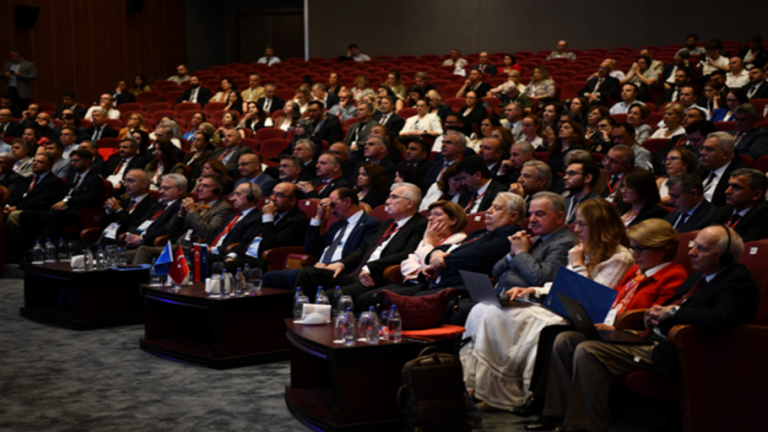
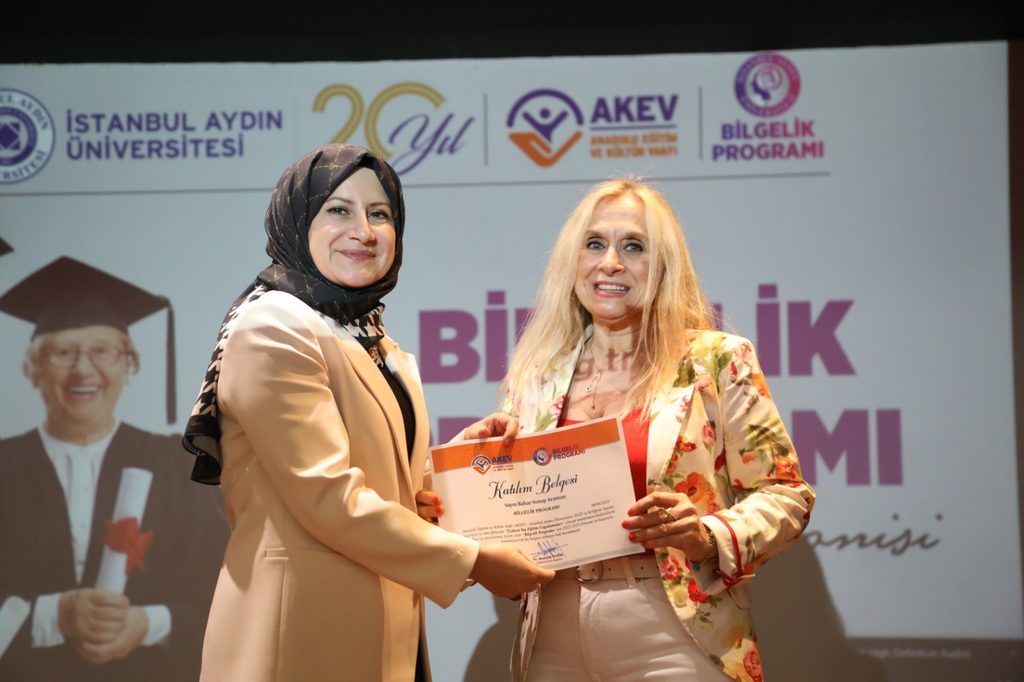
Within this scope, 40 students who wanted to live their retirement years to the fullest and participated in the program were awarded participation certificates at a ceremony held to mark the completion of their first year.
“The university must strive to integrate with society”
IAU Vice Rector Prof. Dr. Reşat Başar stated that they are happy to be involved in such a collaboration as a university and said that they will continue all kinds of efforts within this scope. Prof. Dr. Başar said, “In our view, a university is not only an institution that provides education at the undergraduate or graduate level. A university must strive to integrate with society. Our university carries out many activities in this direction. In addition to the Wisdom Academy, we also have a children’s university. We will always continue to work to sustain such initiatives that encompass all segments of society,” he said.
“Our main goal is to fight Alzheimer’s disease”
Dr. Ali Efe İralı, a faculty member who actively teaches participants within the Program, drew attention to Alzheimer’s disease in the information he shared about the program. Dr. Ali Efe İralı stated, “We are implementing a model of third-age universities adapted to Türkiye. It is a two-year program. Over the course of two years, participants take a wide range of courses from 31 academics, including communication, mathematics, foreign languages, economics, history, and philosophy. At the same time, we support them with regular health-related courses. In fact, our main goal is a program built around fighting Alzheimer’s disease and promoting healthy aging. We try to establish a mentor–mentee relationship between them and university students, so they both share their experiences with young people and receive support from them during the adaptation process to new technologies,” he said.
“We don’t fall into depression, and we say ‘there is no age limit to learning’”
Participants Nuran Kiraz Fidanlık and Fatma Ekinci, both retired teachers, also expressed that they were extremely happy to be part of such an educational process. In addition to sharing their feelings, they said, “We were already among those who taught while learning. There is absolutely no age limit to learning. Above all, this program increased our self-confidence. Making friends, being in a different environment, being together with young students, and the wonderful contributions of the courses to our lives… We experienced indescribable emotions this year. Most importantly, we socialize, we don’t fall into depression, and we are very happy. Even our manual skills improved in the courses here. We also benefit from the energy of young people,” they said.
“We were in a void after retirement”
Retired pharmacist İsmail Gürcüoğlu stated that they were in a sense of emptiness after retirement and that this program helped them greatly, saying, “We learned about this program through our friends. We started reliving our university life from 50 years ago, half a century earlier. We gained new friendships, knowledge, and experiences. When it was our turn to speak in a group, we found a few more words to say. We thank everyone who provided us with this opportunity,” he said.
“Returning to student life again is an incredible feeling”
Retired journalist Metin Dirim emphasized that such programs should become more widespread and expressed the following in his remarks:
“Universities are the places where socialization is at its highest. When we heard about this program, my wife and I enrolled together. We gained many experiences; the most important thing for us was socialization. We had the opportunity to meet young students at the university. Returning to student life again was an incredible feeling for us. We had to be very active, especially mentally. These experiences at this age were very beneficial for us. In the end, there is no age limit to learning. But learning also needs to be explored—how and where to learn. Unfortunately, in our country, retirees often withdraw into isolation after retirement and, if there are grandchildren, they take care of them. Rather than retirees wanting this, universities and the state need to be sensitive. The state needs to support universities both financially and morally in this regard so that these initiatives can spread throughout society and more people can benefit from them.”