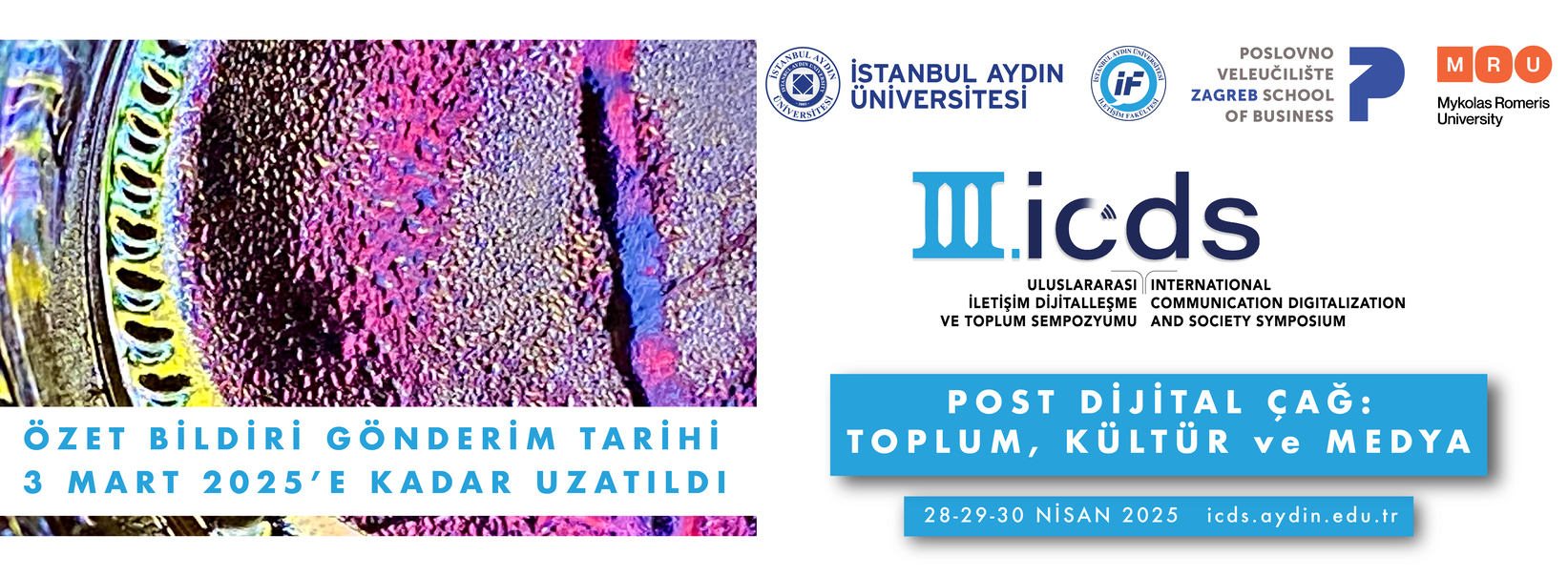

The third International Symposium on Communication, Digitalization and Society hosted by Istanbul Aydın University Faculty of Communication will be held on April 28-29-30 2025, with the theme titled ‘Post-Digital Age: Society, Culture, and Media.’ The symposium, which aims to bring academics, civil society, industry representatives, doctoral students, and graduate students together, will be held in a hybrid format. We kindly invite you to participate in our conference and submit your papers based on the themes and related subjects listed below. Your proposals can be submitted in English or Turkish. The following topics may include but are not limited to:
| Artificial Intelligence and Big Data | Digital Addiction and Psychological Impacts |
| Artificial Intelligence and Social Dynamics | Digital Advertising Strategies |
| Artificial Intelligence and Truth | Digital Art and Culture |
| Audience Studies in the Post-Digital Age | Digital Communication and Radicalism |
| Broadcasting in the Post-Digital Age | Digital Communication and Social Dynamics |
| Celebrity Populism and Politics | Digital Communication and Transformation |
| Climate Change and Media Narratives | Digital Content Manipulation and Violence |
| Communication Psychology in the Digital Age | Digital Cultural Studies |
| Consumer Culture and Digital Transformation | Digital Diseases |
| Crisis Management in the Post-Digital Age | Digital Feminism |
| Cultural Integration and Digital Tools | Digital Identities and Construction of Self |
| Cultural Production and Artificial Intelligence | Digital Identity and Privacy |
| Cultural Production and Digital Platforms | Digital Inequalities |
| Digital Activism and Social Movements | Digital Marketing |
| Digital Addiction and Psychological Impacts | Digital Marketing and Behavioral Consumption |
| Digital Art and Culture | Digital Media and Science Communication |
| Digital Communication and Radicalism | Digital Memory and Identity |
| Digital Communication and Social Dynamics | Digital Popular Culture |
| Digital Communication and Transformation | Digital Radicalism and Political Movements |
| Digital Content Manipulation and Violence | Digital Radicalism and Public Diplomacy |
| Digital Cultural Studies | Digital Radicalism and the Incel Movement |
| Digital Diseases | Digitalization and Game Studies |
| Digital Feminism | Digitalization and Health Communication |
| Digital Identities and Construction of Self | Disinformation in the Digital World |
| Digital Identity and Privacy | Education and Digital Literacy |
| Digital Inequalities | Educommunication and Post-Digital Literacy |
| Digital Marketing | Ethical Issues in Communication and Public Relations |
| Digital Marketing and Behavioral Consumption | Ethics in Digital Media Regarding AI Algorithms |
| Digital Media and Science Communication | Gender Studies in Digital Media |
| Digital Memory and Identity | Harassment, Abuse, and Violence on Digital Platforms |
| Digital Popular Culture | Hate Speech and Hate Crime in Digital Media |
| Digital Radicalism and Political Movements | Human Rights Violations in Digital Media |
| Digital Radicalism and Public Diplomacy | Journalism and Public Relations in the context of Post-Digitalism |
| Digital Radicalism and the Incel Movement | Media and Populism |
| Digitalization and Game Studies | Metaverse |
| Digitalization and Health Communication | Migration, Identity, and Digitalization |
| Disinformation in the Digital World | New Business Models in Social Media |
| Education and Digital Literacy | Philosophy of Communication and Ethics |
| Educommunication and Post-Digital Literacy | Political Economy of Digital Media |
| Ethical Issues in Communication and Public Relations | Popular Culture and Digital Consumption |
| Ethics in Digital Media Regarding AI Algorithms | Post-Digital Age and Cinema |
| Gender Studies in Digital Media | Post-Digital Age and Radio Studies |
| Harassment, Abuse, and Violence on Digital Platforms | Post-Digital Age and Television Studies |
| Hate Speech and Hate Crime in Digital Media | Post-Digital Artists and Content Producers |
| Human Rights Violations in Digital Media | Post-Digital Work Culture and Freelance |
| Journalism and Public Relations in the context of Post-Digitalism | Postmodern Advertising Campaigns in Digital Networks |
| Media and Populism | Post-Truth Journalism |
| Metaverse | Public Relations in the Post-Digital Age |
| Migration, Identity, and Digitalization | Reality and Hyperreality |
| New Business Models in Social Media | Reputation Management in Digital Networks |
| Philosophy of Communication and Ethics | Social Media and Populist Communication Strategies |
| Political Economy of Digital Media | Social Media and Radicalization Processes |
| Popular Culture and Digital Consumption | Social Media and Societal Impacts |
| Post-Digital Age and Cinema | Social Media Psychology |
| Post-Digital Age and Radio Studies | Social Representations in Digital Media |
| Post-Digital Age and Television Studies | Spatial Narratives in the Post-Digital Age |
| Post-Digital Artists and Content Producers | Storytelling and Post-Digital Rhetoric |
| Post-Digital Work Culture and Freelance | Sustainable Digital Technologies |
| Postmodern Advertising Campaigns in Digital Networks | The Digitalization of Visual Culture |
| Post-Truth Journalism | Virtual Reality and Game Culture |
| Public Relations in the Post-Digital Age | Virtual Reality and Hyperreality |
| Reality and Hyperreality | Virtual Reality and Space |
| Reputation Management in Digital Networks | Visual Culture and Politics |
The post-digital age refers to a period that follows the widespread adoption of digital technologies, where these technologies have profoundly had impacts on social, cultural, and economic domains and have been fully internalized into our daily lives and societal structures. This concept highlights a paradigm shift where digitalization is not merely a tool but a force that shapes the identities, interactions, and experiences of individuals and communities. In this era, where the privileged position of digital technologies has diminished, there is a deep interrogation of its effects on media, society, and culture. Digital tools have led to profound changes not only in terms of technological innovations but also in social relations, cultural practices, media content, and identity formation. This symposium aims to address the transformation of media practices, society’s responses to the digitalisation process and the reshaping of cultural production processes, focusing on the post-digital age.
Accordingly, the symposium focuses on questions about how the post-digital era and digitalization process have transformed media dynamics and social structures. Another theme within the symposium is how cultural production processes are redefined thanks to digital technologies. Participants will discuss this era from a critical and multiple perspectives which digital is no longer seen as a novelty but an integral part of the social fabric. Understanding the possibilities and limitations of an era beyond digitalization is vital for shaping the future of social and cultural interactions.
Owing to the perspective mentioned above, the key motivation of the 3rd International Symposium on Communication, Digitalization, and Society is to provide an open platform for knowledge exchange and to create a space for discussions about the impacts of the post-digital era on media, society, and culture. These discussions will engage a diverse array of stakeholders, particularly academics who will deepen the relevant themes and questions. The opening speeches of the symposium will be delivered by Prof. David M. Berry from the University of Sussex, Prof. Charlie Gere from Lancaster University, and Prof. Cem Sefa Sütçü from Marmara University. We warmly welcome original contributions from scholars around the world and are looking forward to your valuable participation and contribution for the symposium.
Symposium Calendar:
Deadline for Abstract Submission: February 10, 2025
Acceptance of Abstracts: March 24, 2025
Registration Deadline: March 31, 2025
Program Announcement: April 18, 2025
Symposium Dates: April 28-29-30, 2025
Publication of Abstract Book: May 12, 2025
Full Paper Submission Deadline: July 28, 2025
Please find the details about the symposium at the following link: https://icds.aydin.edu.tr/
Assoc. Prof. Dr. Veli Boztepe
Istanbul Aydın University
Acting Dean, Faculty of Communication